
Table Of Contents
Indian human hair is one of the most wanted beauty products in the world.
From temple offerings in the South of India to bundles sold in New York salons, this is a quiet billion-dollar trade.
If you want to sell Indian hair, one big question comes up first.
Should you sell to China or to the USA?
Both markets want Indian hair.
The difference is that they want it in very different forms.
Choose the wrong market, and you fight a losing battle.
Choose the right one, and you build a business that lasts.
Let us break it down in plain language.
India Is The King Of The Hair Trade
Before you choose a buyer, it helps to know your own strength.
As an Indian seller, that strength is huge.
India supplies most of the world’s raw human hair.
No other country comes close.
You are starting from the best source in the world, not chasing it.
The most prized type is temple hair.
Millions of devotees shave their heads at temples as a religious offering.
This hair is never dyed, bleached, or chemically treated.
It is strong, soft, and silky.
That quality is why buyers across the world ask for Indian hair by name.
It holds color well.
It lasts for years.
It blends naturally with most hair types.
So you are not selling a common product.
You are selling the gold standard.
Did You Know? The famous Tirumala temple in Andhra Pradesh earns a fortune from hair that devotees give away for free. In peak years, its global hair auctions have crossed 200 crore rupees. Selling this hair is the temple’s second biggest source of income, right after cash offerings. A humble offering becomes a worldwide beauty product.
What China Actually Wants From You
China is the factory of the global hair industry.
If you have ever bought a wig anywhere in the world, there is a strong chance it was made in China.
Chinese buyers want raw, unprocessed hair in bulk.
They buy it by the kilo.
They are not looking for a finished product.
They want raw material to feed their factories.
The center of this trade is a city called Xuchang in Henan province.
It is often called the wig capital of the world.
Huge units there turn imported hair into wigs and extensions, then sell those products to America, Africa, and Europe.
China is happy to buy almost every grade.
It takes long temple hair, but it also takes short, broken, and tangled hair that other buyers reject.
It even buys loose hair collected from combs and homes.
This sounds easy, and the volume is real.
The problem is the profit.
Selling raw hair to China is a pure price game.
The margins are thin.
You win only on low cost and steady supply.
You will also be competing with big, established players, as Chinese agents already sit at South Indian hair auctions and buy at scale.
In short, China is a fast door, but a crowded one.
You remain a supplier, not a brand.
What The USA Actually Wants From You
The USA is a very different opportunity.
America does not want your raw hair.
America wants the finished product.
This means wigs, ready-made bundles, closures, and frontals.
These items are sold to distributors, beauty supply stores, salons, and more, as well as directly to shoppers online.
The biggest engine here is the Black hair-care community, which spends heavily on weaves, wigs, and extensions every year.
Demand is strong, loyal, and growing.
The best part is the margin.
A finished product, especially one sold under a brand built around real Indian temple hair, earns far more than raw hair ever will.
There is also a story advantage that Western buyers truly value.
Temple hair is ethically given, single-source, and traceable to its origin.
In a market full of mystery-sourced hair, an honest origin story is a real selling point.
Now for the harder part.
‘To win in the USA, you need a finished product.
That means you either process the hair yourself in India, which takes skill and capital, or you work with a partner to white-label it.
On top of that, you need marketing, a brand, and a way to ship to customers.
The market is also crowded.
Here is an open secret of the trade.
Many brands in the USA that claim to sell raw Indian hair are quietly reselling Chinese-processed hair.
Real, traceable Indian hair is a genuine edge, if you can prove it.
So the USA is a slower door, but a far richer room.
You become a brand owner, not just a seller.
China Or USA: A Simple Comparison
Here is a clear side by side view to make the choice easier.
| Point | Selling To China | Selling To USA |
|---|---|---|
| What they buy | Raw, unprocessed hair by the kilo | Finished wigs, bundles, and extensions |
| Main buyers | Wig and extension factories | Distributors, salons, and online shoppers |
| Margins | Thin — you compete mainly on price | Strong — especially when you build a brand |
| Barrier to entry | Lower, but highly crowded with big players | Higher — requires product development & marketing |
| Your role | Bulk supplier | Brand owner or premium product seller |
| Biggest risk | Price wars and entrenched agents | Crowded market + need for processing & branding |
| Best for | Fast cash flow and high volume | Long-term brand building and better profit margins |
| Best Choice | Recommended When… |
|---|---|
| China | You have easy access to raw hair, limited capital, and want quick turnover |
| USA | You can invest in processing/branding and want to build a real business with higher profits |
Raw VS Processed Hair: Where The Money Hides
To choose well, you need to understand where the money actually sits in this business.
Raw hair is the lowest value point in the chain.
Every step after that adds value.
Cleaning adds value.
Sorting by length adds value.
Turning hair into a bundle or a wig adds even more.
Putting a trusted brand name on it adds the most.
Here are rough industry ranges to make this real.
These are not fixed prices; they change with quality, length, and demand.
However, they clearly show the gap.
Export-grade raw temple hair sells for roughly 65 to 150 US dollars or more per kilo.
Long, uniform Remy hair sits at the top of that range.
As you will see below, $ 65 is now also the legal floor for export.
Once the same hair is processed into bundles or wigs and sold under a brand in the USA, the finished product is often worth several times more.
In many cases, it is 4 to 10 times the raw cost.
That is the whole story in one line.
Raw hair earns the least.
The branded, finished product earns the most.
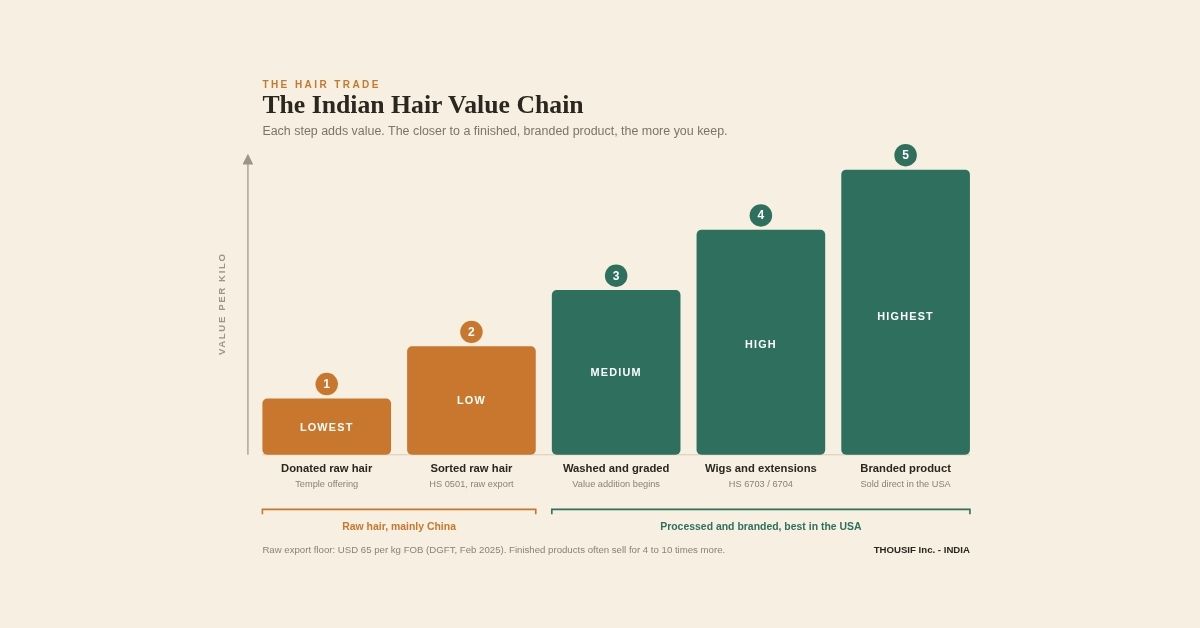
From a temple offering to a branded product, each step up the chain adds value.
If you only sell raw hair, you hand all of that extra value to someone else, usually a factory abroad.
You do the sourcing.
They take the profit.
The table below shows how different grades of Indian hair map to different markets and value levels.
| Hair Type | What It Is | Main Market | Relative Value |
|---|---|---|---|
| Temple Remy hair | Long, uniform, cuticle intact | USA and Europe | Highest |
| Single drawn bundles | Mixed lengths, good quality | USA, Europe, salons | High |
| Non-Remy hair | Short, broken, or tangled | China (for processing) | Low to Medium |
| Comb waste | Loose shed hair from homes | China (for processing) | Lowest |
| Value Level | Recommendation |
|---|---|
| Highest | Best for USA/Europe branded products |
| High | Good for premium bundles & extensions |
| Low to Medium | Usually sold raw to China for processing |
| Lowest | Lowest margin — mostly sent to China |
The lesson is simple.
The closer you get to a finished, branded product for the customer, the more money you keep.
What You Need To Start Exporting From India
The basic business setup in India is straightforward.
The rules for the product itself need more care, and they have recently changed.
First, the setup.
You need an Importer Exporter Code (IEC) from the Directorate General of Foreign Trade.
You also need to register for GST for your business.
Raw human hair is under HS code 0501, processed or worked hair under 6703, and finished wigs under 6704.
You do not need an FSSAI license because hair is not food.
Now the important update.
Important update (2025): Export of raw, unworked human hair under HS code 0501, priced below 65 US dollars per kilo FOB, is now prohibited by DGFT. Export is allowed freely only when the FOB value is at least 65 dollars per kilo. This rule was brought in to stop under-invoicing and smuggling. Always check the latest DGFT notification before you plan any shipment.
This change matters for your strategy.
The government is clearly steering sellers away from cheap raw exports and toward value addition at home.
That is good news if you plan to build a processed, branded product, because that is exactly the direction the policy rewards.
It is also worth noting that processed hair under HS code 6703 follows different, and generally easier, rules than raw hair under HS code 0501.
This is one more reason to move up the value chain rather than stay at the raw end.
On the supply side, the southern temple belt in Andhra Pradesh, Telangana, and Tamil Nadu is a key source of raw hair, while West Bengal is a major hub for the wider trade.
Chennai is an important center for processing and export.
Finally, start small and start smart.
Send samples first.
Build trust with one or two serious buyers before you chase big volume.
In this trade, reliability and honest grading build your name faster than anything else.
So, Where Should You Actually Go?
Now to the real answer.
If you only have access to raw hair, your capital is tight, and you want quick cash flow, China is the easier door to open.
Just remember the cost of that choice.
You remain a small supplier on thin margins, competing with bigger players on price.
You are also now boxed in by the 65 dollar export floor.
If you can build a brand, handle processing or white-labeling, and play a longer game, the USA is where the real profit and a business you own actually live.
For most Indian entrepreneurs who want to build something that lasts, the USA route is the smarter bet.
However, you must solve the product question.
A brand without a reliable, quality product will not survive a crowded market.
So our honest advice is this.
Do not chase China unless you fully control a cheap, reliable end-to-end supply of raw materials.
Instead, aim for the USA.
Solve the sourcing and processing first, then sell a branded product you are proud of.
That is where a seller like you wins.
The hair is Indian.
The quality is world-class.
The only real question left is how much of that value you choose to keep for yourself.
A Final Word
The global hair trade is one of the most fascinating businesses.
It begins with a quiet offering in an Indian temple and ends as a beauty product on a shelf thousands of miles away.
As an Indian seller, you stand right at the source of it all.
Choosing between China and the USA is not about which country is better.
One last thing.
We would love to hear from you.
Are you leaning toward the China route or the USA route, and what is holding you back?
Tell us in the comments below.
Moreover, if you enjoyed this, do explore more of our articles on trade, business ideas, and smart ways to grow.
There is plenty more waiting for you, and we love sharing what we learn along the way.
About Author