
Table Of Contents
Summary
The China-Kyrgyzstan-Uzbekistan railway, often shortened to the CKU railway, is a new overland freight line built to carry goods from China across Central Asia toward the Middle East and Europe. For traders, it is a possible new option for moving cargo, with real strengths and a few honest catches.
Here are the key facts at a glance.
| Item | Detail | Notes |
|---|---|---|
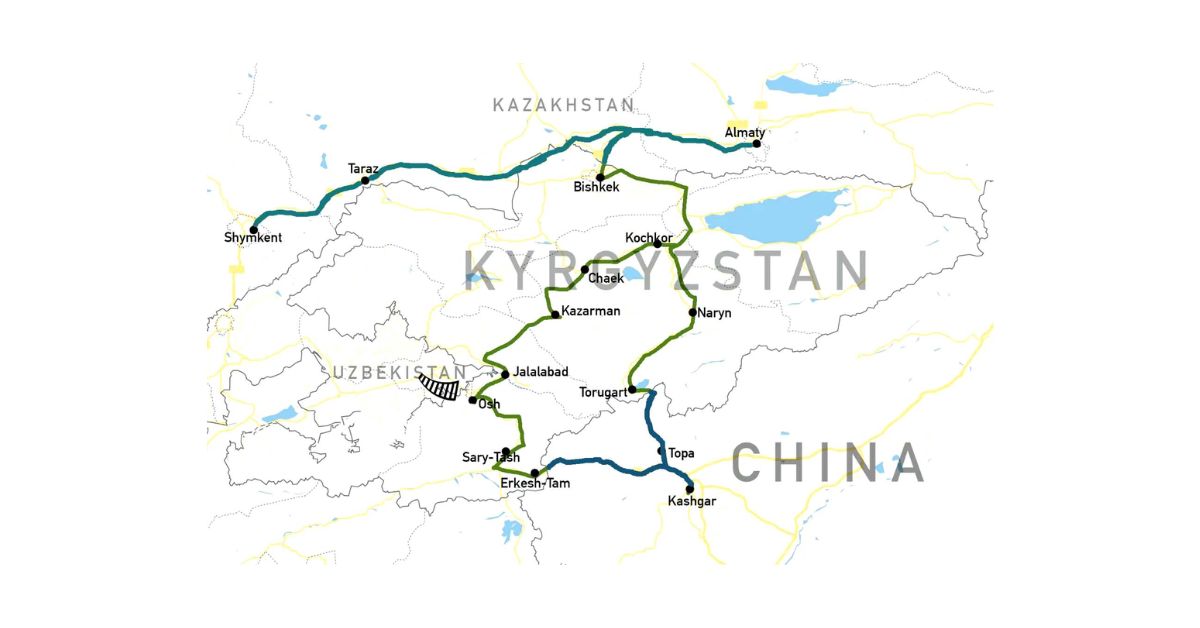
| Route | Kashgar (China) → Torugart Pass → Kyrgyzstan (Makmal, Jalal-Abad) → Andijan (Uzbekistan) | Fully overland route |
| Total length | Approximately 523 km (reports range 486–532 km) | Slight variations due to measurement points |
| Kyrgyz section | ~260–305 km | The majority of new construction |
| Total estimated cost | ~$8 billion | Overall project framing |
| Kyrgyz section cost | $4.7 billion | Main focus of financing |
| Funding model | Joint Venture company China 51%, Kyrgyzstan 24.5%, Uzbekistan 24.5% | China is providing ~$2.35 billion 35-year loan to the JV |
| First proposed | 1997 | Memorandum of Understanding |
| Key agreement signed | June 2024 | Intergovernmental agreement |
| Construction launched | December 2024 (ceremonial start) | Major tunnel construction began in April 2025 |
| Current status (June 2026) | Active construction phase | Key tunnels underway |
| Planned construction period | ~6 years | Target completion ~2030–2031 |
| Track type (initial) | Single-track, non-electrified (diesel) | Future electrification planned |
| Gauge difference | China: 1,435 mm (standard) Kyrgyzstan & Uzbekistan: 1,520 mm (broad) | Requires transshipment |
| Break of gauge location | Makmal station, Kyrgyzstan | Cargo transfer or wheelset change |
| Major engineering works | 29 tunnels + 50 bridges | ~40% of Kyrgyz section |
| Design speed | ~120 km/h (planned) | Mountainous terrain |
| Main advantage vs other routes | Fully overland (avoids Russia + Caspian Sea ferry) | Better reliability option |
| Projected time saving | Up to 7–10 days | For China to West Asia / Europe traffic |
| Kyrgyzstan transit revenue | ~$200 million per year (projected) | Once fully operational |
The sections below explain each of these in detail, so every part of the story stands on its own.
What The CKU Railway Actually Is
The line starts in Kashgar, a city in the Xinjiang region of western China.
From there, it crosses into Kyrgyzstan through the Torugart Pass, winds through the country’s mountainous middle, and continues into eastern Uzbekistan, ending in Andijan, where it joins existing rail tracks.
The Kyrgyz part of the line runs about 304 kilometres.
Reports of the full length vary slightly from one source to another, which is why you will see figures ranging from 486 to 523 kilometres.
The difference comes down to where each source starts and stops measuring.
The terrain is the hard part.
The route climbs through high, geologically unstable mountains.
To get through them, the plan calls for about 29 tunnels and around 50 bridges, including several very long tunnels cut straight through the rock.
To keep early costs down, the Kyrgyz section is being built as a single-track diesel line, with the option to add electric power later.
In simple terms, single track means trains in both directions share one set of rails and must take turns, which limits how much they can move at once.
A Project Nearly Three Decades In The Making
The railway feels new, but the idea is old.
China, Kyrgyzstan, and Uzbekistan first signed a memorandum to build it in 1997.
Then came nearly thirty years of surveys, arguments over the route, and long talks about who would pay.
The agreement that finally unlocked the project was signed in 2024.
Construction was launched at a ceremony in Kyrgyzstan in December of that year.
With a build planned over about six years, the line is expected to be ready toward the end of the decade.
Trivia Worth Sharing: The CKU railway was agreed on paper back in 1997. That means some of the young engineers working on the tunnels today were not even born when the three countries first promised to build it.
What It Costs And Who Pays
The full project is estimated at around $ 8 billion.
The Kyrgyz section by itself is estimated at 4.7 billion dollars.
That price tag is the heart of the debate.
It is very large relative to the Kyrgyz economy, which is why so many people closely watch the finances of this railway.
The cost is shared in three ways.
| Partner | Share | Role |
|---|---|---|
| China | 51% | Builds and funds its own section (from Kashgar to Torugart border). Provides the majority of project financing, including a ~$2.35 billion 35-year concessional loan to the Joint Venture company. |
| Kyrgyzstan | 24.5% | Owns 24.5% of the Joint Venture. Its share of the $4.7 billion Kyrgyz section is largely financed through a Chinese loan to the JV (to be repaid by the Joint Venture, not directly by the government). |
| Uzbekistan | 24.5% | Owns 24.5% of the Joint Venture. Primarily upgrades and integrates its existing rail network near Andijan with minimal new construction required. |
The Kyrgyz section is built and run through a joint venture company owned by all three states.
A joint venture means the partners pool money and share both the risks and the rewards, rather than one country carrying everything alone.
The loan is the point to understand clearly.
To cover its share, Kyrgyzstan plans to borrow around 2.35 billion dollars from China, structured over about 35 years and meant to be repaid by the joint venture rather than by the government alone.
This matters because Kyrgyzstan already owes a great deal.
Its public debt is nearly half of its annual national output, and roughly $ 1.8 billion of that is already owed to China, its largest lender.
The shared model spreads the risk, yet the railway still adds to a debt load that was heavy before the first tunnel was dug.
The Gauge Problem At The Border
This is the detail most headlines skip, and it is the one traders should understand best.
Railways run on tracks set a certain width apart.
That width is called the gauge.
China uses the standard gauge, set at 1,435 millimetres.
Kyrgyzstan and Uzbekistan, like the rest of the former Soviet region, use a wider gauge of 1,520 millimetres.
Because the two widths do not match, a train cannot simply roll from one country into the next.
At the border, the cargo has to be lifted from one set of wagons onto another, or the wheels under each wagon have to be swapped out.
This switch is called transshipment, or a break of gauge.
It is not just a technical footnote.
Along the existing China-to-Kazakhstan border, this same gauge change adds between 24 and 36 hours to a typical crossing.
So when anyone promises that the CKU railway will be faster or cheaper, the honest answer is that the savings should always be measured after border handling is included, not before.
How It Compares With Other China To Europe Routes
The CKU railway does not arrive in an empty field.
Goods already travel from China to Europe by rail along two main paths, and knowing them shows exactly where this new line fits.
The first is the Northern Corridor, which runs through Kazakhstan, Russia, and Belarus into the European Union.
The second is the Middle Corridor, also called the Trans-Caspian route, which avoids Russia by crossing the Caspian Sea and passing through the Caucasus and Turkey.
The story behind these numbers is useful.
The Northern Corridor once carried the large majority of China’s rail freight to Europe.
After 2022, many shippers grew wary of routes through Russia, and traffic on that path fell sharply.
Attention has turned to the Middle Corridor, but it has a weak link: cargo must cross the Caspian Sea by ferry, and ports there have seen long queues, with hundreds of containers waiting for many days during peak periods.
This is the gap the CKU railway aims to fill.
It offers a route that skips Russia and the Caspian Sea, staying on solid ground the whole way.
That overland continuity is its real selling point.
What The Corridor Offers Traders
For people who actually move goods, the appeal comes down to a few practical points.
The first is distance and time.
The route is projected to shorten the journey between western China and onward markets in Iran, Turkey, and Europe by around 900 kilometres and cut up to 8 days from current overland travel.
Shorter distance does not always mean shorter time, as the Middle Corridor has shown, but a clean overland path gives the CKU railway a fair chance to deliver on that promise.
The second is choice.
Having a third route lets shippers spread risk.
If one corridor is blocked, delayed, or politically awkward, cargo can shift to another.
In freight, options are valuable in their own right.
The third is access for landlocked nations.
Both Kyrgyzstan and Uzbekistan are landlocked, with no coastline of their own.
This line gives them a fresh connection to world markets that does not depend on a single neighbour.
Kyrgyzstan has projected transit income of around $ 200 million per year once trains are running.
The fourth is what the route passes.
It runs near deposits of coal, gold, aluminium, and iron, which could spur new mining and create fresh freight to fill the trains.
The kinds of goods that already dominate this style of rail freight include electronics, vehicles and car parts, and farm produce, and the CKU railway is well placed to carry the same mix.
The Open Questions Worth Watching
A fair guide keeps the uncertainties in plain view.
The first is capacity.
A single-track diesel line through mountains can only carry so much at the start, so early volumes may be modest until the line is upgraded.
The second is revenue.
Those projected transit earnings depend on cargo turning up at the forecast volumes.
If it does, the debt becomes easier to carry.
If it does not, the strain grows.
The third is timing.
Long tunnels through unstable rock are famous for running late.
Completion dates are best read as targets, not promises.
A Friendly Word To Wrap Up
The China-Kyrgyzstan-Uzbekistan railway is best seen as a long game.
It will not change global trade overnight, but it adds a useful new path between China and Europe, one that sidesteps both Russia and the tricky Caspian crossing.
The savings look real as long as you remember to account for the gauge change at the border, and the financing is shared, even if it leans on a country already deep in debt to China.
If you found this helpful, there is plenty more where it came from.
We cover trade routes, export ideas, and the practical side of moving goods across borders every week, all written in the same clear and honest style.
Have a look around the blog, and we hope to see you on your next read.
About Author